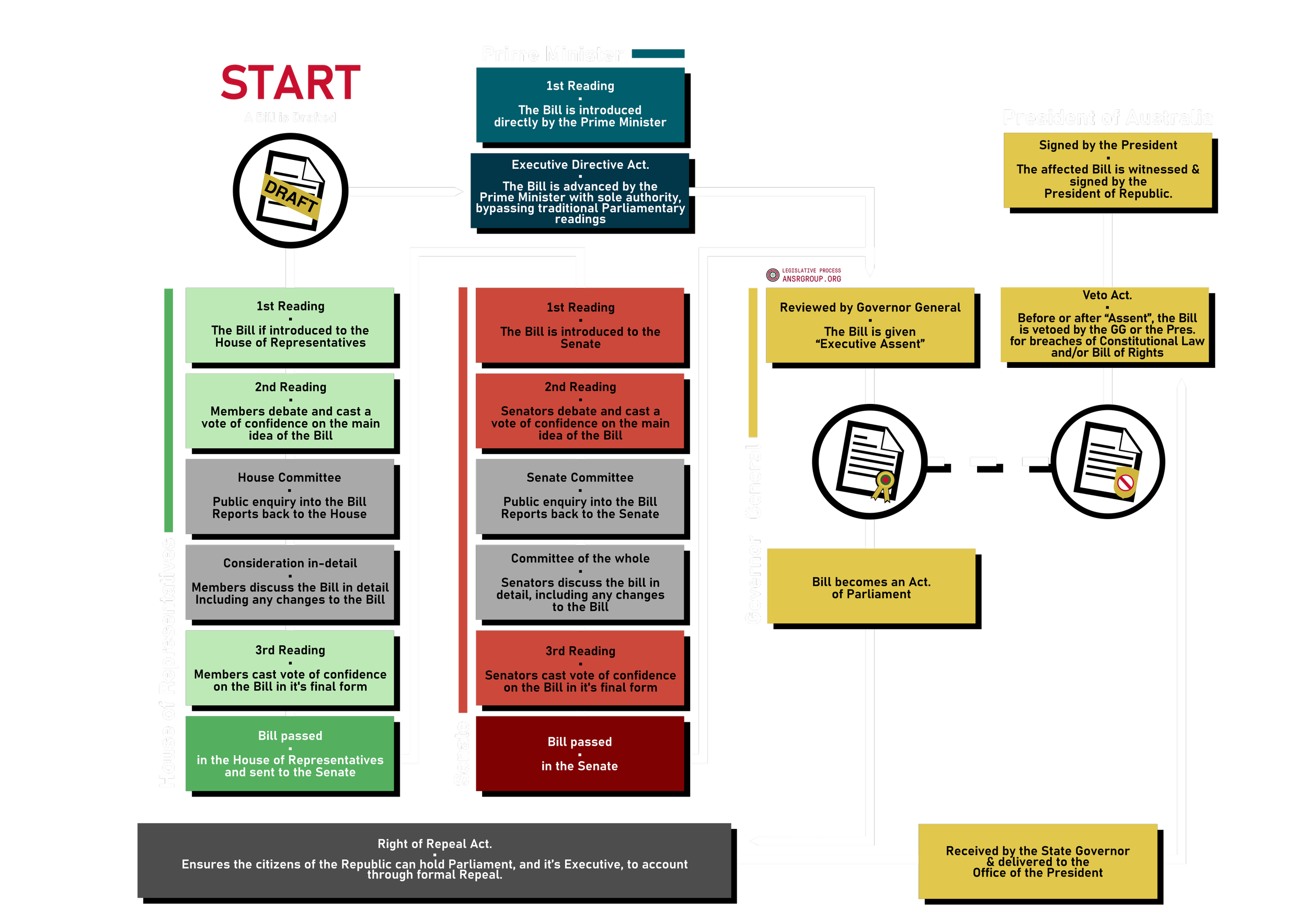
Legislative Process
Introduction to the Republic Parliament:
The ANSR system of governance builds upon many familiar elements of the Commonwealth parliamentary tradition while introducing structural reforms designed to improve representation, expertise in law-making, and the government’s ability to act when necessary.
This is because legislation in the ANSR reflects both the practical realities/expertise of the workforce, as well as the regional needs & interests of communities across the republic. The legislative authority of the republic is therefore shared between:
the House of Representatives, representing Australia’s occupational interests and professional expertise.
the Senate, providing a geographic check for Australia’s regional interests and the communities within its states.
Together, these institutions form the legislative framework of the ANSR system.
House of Representatives:
In traditional Commonwealth systems, members of the House of Representatives are elected from geographic constituencies. The ANSR system retains the central legislative role of the House but reforms how its members are chosen.
Instead of geographic electorates, members of the House of Representatives are elected by professional and industry constituencies. Citizens participate in elections within the sector of the economy in which they primarily work or contribute.
For example, healthcare professionals elect representatives from the medical and health sector, agricultural workers elect representatives from the agricultural sector, and educators elect representatives from the education sector.
The House of Representatives remains the primary chamber for the introduction and debate of legislation, where bills are examined, amended, and prepared for review by the Senate.
The Senate:
Serving as the upper chamber of Parliament and representing the geographic interests & communities of the republic.
In many Commonwealth systems, upper chambers already function as bodies of regional representation. The ANSR system retains this familiar principle. While the House of Representatives reflects the professional and economic structure of society, the Senate ensures that the geographic interests of the nation’s states, territories, and communities remain protected within national law-making.
Senators are elected by citizens within defined territorial constituencies. Their role is to represent the needs, conditions, and priorities of the regions in which people live. This ensures that legislation is not shaped solely by sectoral or economic interests, but also considers the realities faced by different parts of the country.
The Senate reviews legislation passed by the House of Representatives and may debate, amend, or reject proposed laws. In doing so, it provides an additional layer of scrutiny and helps ensure that national legislation is balanced between industry expertise and regional fairness.
Through this relationship between the two chambers, the ANSR Parliament reflects two fundamental aspects of representation:
what people do (through occupational representation in the House)
where people live (through geographic representation in the Senate)
Together, these chambers form a legislative system designed to balance economic knowledge with regional stability.
Legislative Passage:
For legislation to become law in the ANSR system, it must be considered and approved by both chambers of Parliament.
A bill is typically introduced in the House of Representatives, where members representing professional sectors debate its purpose, examine its practical effects, and propose amendments where necessary. Once the House approves the bill, it is sent to the Senate.
The Senate then reviews the legislation from a regional perspective. Senators may debate the bill, suggest amendments, or return it to the House for further consideration. This process ensures that proposed laws are examined from both the perspective of the nation’s industries and the needs of its communities and regions.
When both chambers agree on the final form of a bill, it proceeds to the Governor-General for Executive Assent.
Executive Assent: After a bill has been passed by both the House of Representatives and the Senate, it is presented to the Governor-General. If the Governor-General is satisfied that the Bill does not infringe on the Republic Bill of Rights or violate the Republic Constitution, the Bill is granted “Executive Assent” by the Governor-General (on behalf of the President) — Confirming that the Bill has completed the proper parliamentary process & formally becomes law within the Republic.
Executive Directive: While the ANSR system vests primary legislative authority in Parliament, it recognises that urgent circumstances may require the government to act swiftly in the national interest. The “Executive Directive” grants the Prime Minister the authority to bypass traditional parliamentary hearings and present the bill to the Governor General for Executive Assent. This is to ensure that the state can respond decisively to protect national security and maintain stability.
The use of the Executive Directive carries full accountability: the Prime Minister assumes complete legal and political responsibility for any action taken under this authority. Its exercise is highly visible, and misuse will certainly result in rapid loss of public confidence and parliamentary support. Through this mechanism, the ANSR system balances the reality of executive power with the need for political consequence and institutional oversight, ensuring that decisive action does not compromise democratic governance.